THENGA
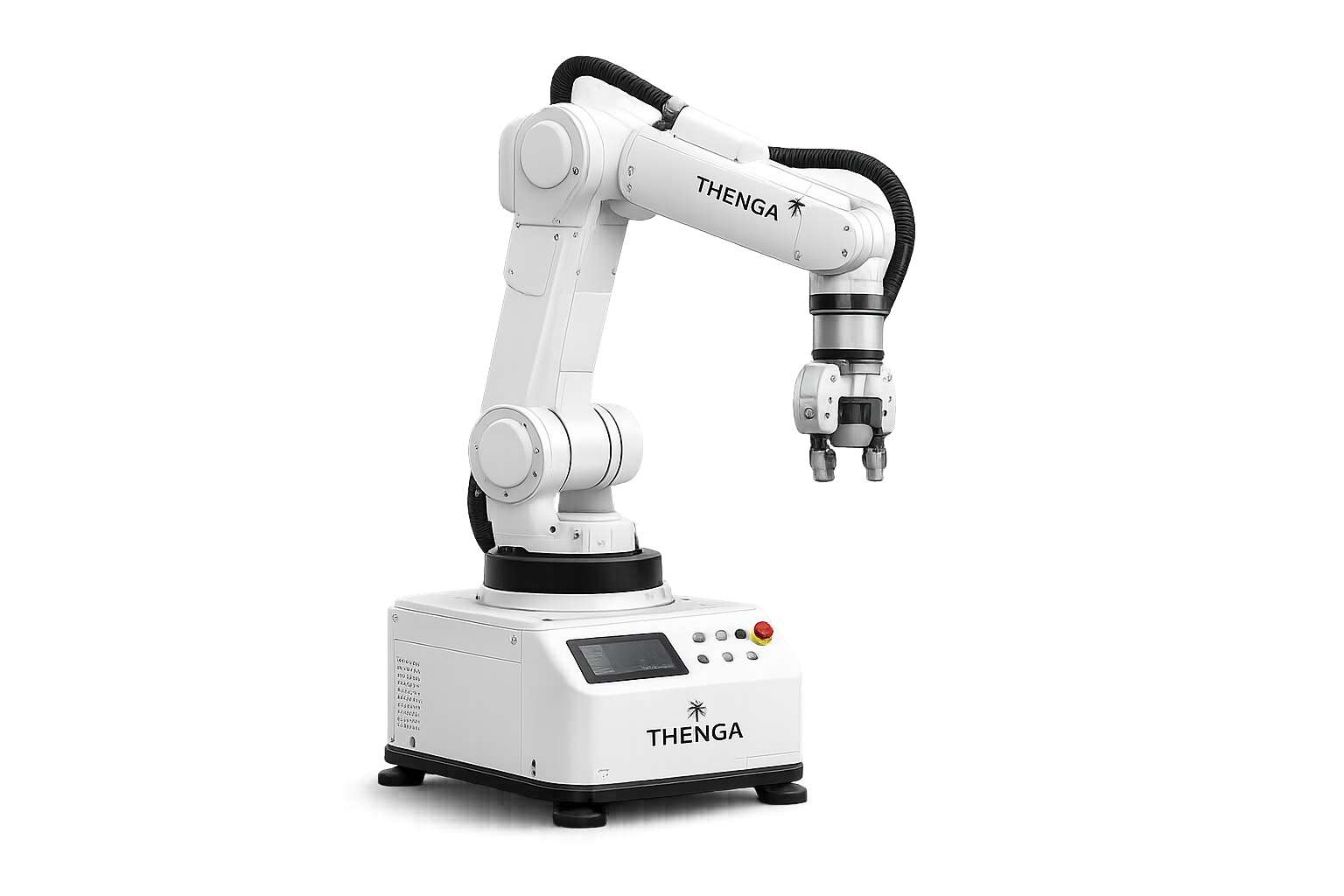
Thenga is the Malayalam word for coconut — and the name of a concept for rethinking how copra is produced in Kerala. A fully autonomous monolithic machine called THENGA ONE, and a compact semi-automatic robotic arm called THENGA ARM built for smaller rural operations.
Copra production in Kerala is still largely manual — physically demanding, time-consuming, and increasingly difficult to sustain as agricultural labour shrinks. This explores what a purpose-built intelligent machine for this specific workflow might look like: not a generic industrial robot repurposed, but something designed ground-up for the coconut.
"Kerala produces over 40% of India's coconuts. Yet copra processing — the most labour-intensive step — remains almost entirely manual. That felt like a design problem worth solving."
— Design Rationale, THENGA
The Problem with Manual Copra Extraction
Traditional copra deshelling using a para — a bamboo tool used to pry copra from the shell. The process is almost unchanged for generations.
Copra extraction — separating the dried coconut meat from the shell — is the most physically demanding step in the entire process. Workers use a tool called a para, made from bamboo, to pry the copra away from the shell.
Each coconut half is worked individually, coaxing the meat loose by hand. It is done entirely at floor level, for hours at a stretch, with no mechanical assistance. The toll on the body is severe and cumulative.
An experienced worker can process roughly 1,000–1,500 coconuts per day under good conditions. Fatigue, difficult batches, or heat significantly reduce this — and there is no way to scale the process without simply adding more workers.
Inconsistent Adhesion
Not all copra releases the same way. Older or under-dried coconuts have copra that bonds tightly to the shell, requiring significantly more force per strike. Workers have no way to predict or control this — each coconut is a small gamble.
Prolonged Floor-Level Posture
The deshelling spike is fixed to the floor, which means workers sit or crouch at ground level for the entire shift — sometimes 6 to 8 hours. This causes chronic lower back pain, knee strain, and hip joint deterioration over time.
Repetitive Strain Injuries
The repeated striking and prying motion puts continuous stress on the wrists, elbows, and shoulders. RSI is extremely common among experienced copra workers, and there are no ergonomic alternatives currently in use at scale.
Flying Shell Fragments
Coconut shells shatter unpredictably on impact. Sharp fragments frequently fly toward the face and eyes. Eye injuries are a documented occupational hazard, and most workers operate without protective gear in informal settings.
Heat and Humidity Exposure
Copra processing happens outdoors or in poorly ventilated sheds, often during peak summer. Workers are exposed to high heat and humidity for the entire workday, accelerating fatigue and increasing the risk of heat-related illness.
Low and Variable Throughput
An experienced worker can process roughly 1,000–1,500 coconuts per day under good conditions. Fatigue, difficult batches, or heat significantly reduce this. The unpredictability makes it hard for producers to plan output.
Broken Copra and Quality Loss
Manual extraction frequently breaks the copra into uneven pieces. Broken or thin copra fetches a lower market price. There is no quality control built into the manual process — consistency depends entirely on individual skill.
Shrinking Labour Availability
Younger generations in Kerala are increasingly unwilling to take on copra processing work. The combination of physical hardship, low pay, and social stigma means the skilled labour pool is shrinking — and there's no pipeline to replace it.
Ideation
The earliest sketches were less about form and more about sequence. What are all the steps a coconut goes through to become packaged copra? How do those steps map onto a physical machine? Where does the process break down when you try to automate it?
Sketching helped expose the hardest mechanical problems early — particularly around handling irregular coconut geometry and the variability in copra adhesion. These became the central design constraints that shaped both THENGA ONE and THENGA ARM.
Once the processing sequence was clear, the architecture of the machine started to follow naturally — a linear flow through stages, each one handing off to the next without human intervention.
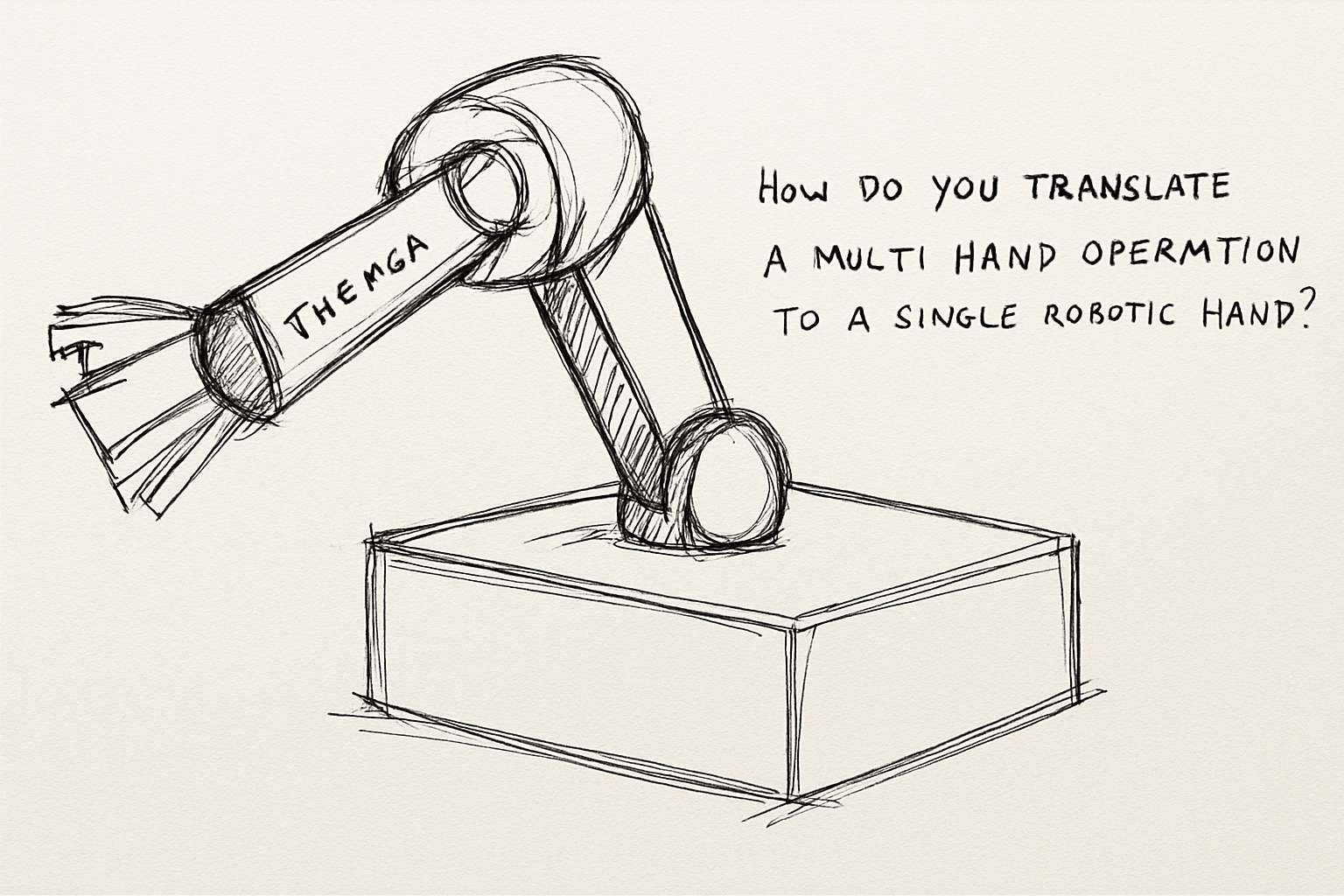
Early sketches exploring machine architecture, processing sequence, and form language before moving into 3D visualisation.
Design Intent
One machine. No operators. Raw coconuts in, packaged copra out.
White powder-coated aluminium, glass inspection panels, green status lighting — precision that feels calm.
- Zero human touchpoints in the processing chain
- AI vision for consistent coconut handling
- Serviceable panels for maintenance access
- Compact enough for cooperative-scale deployment
- Designed to feel trustworthy, not threatening
THENGA ONE — Fully Automated
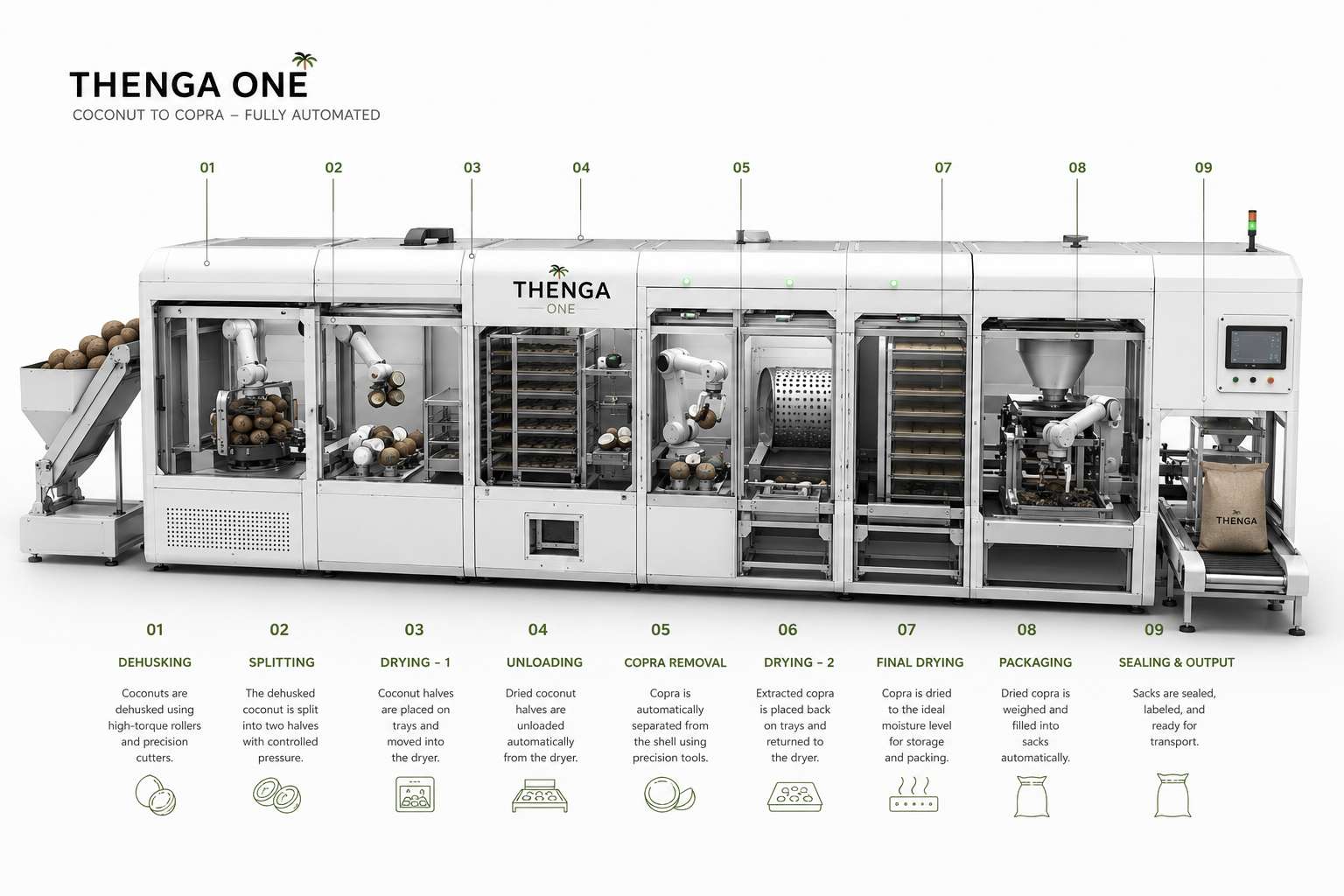
Nine autonomous processing stages in a single continuous machine, from raw coconut intake to sealed copra sacks. Renders generated using ChatGPT.
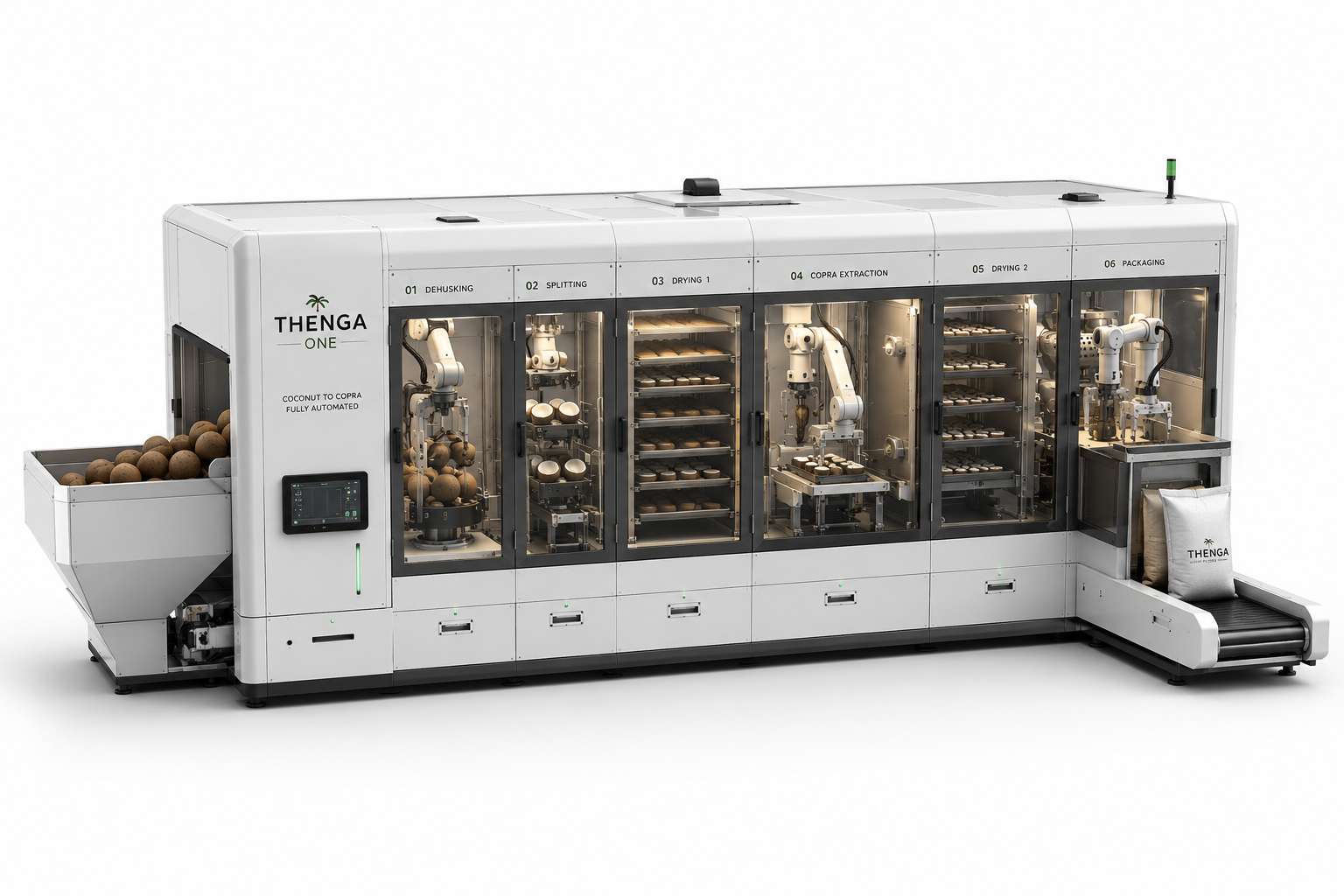
A machine designed to disappear into the process
THENGA ONE is a monolithic machine that processes coconuts from intake to packaged copra without any human intervention. The transparent inspection panels make the internal workflow visible — a deliberate choice that signals intelligence and builds trust with operators.
The visual language is intentionally restrained — white powder-coated aluminium, minimal panel detailing, green status LEDs. It is meant to feel like precision equipment, not industrial machinery. Farmers and cooperative managers should be able to read its state at a glance and trust what they see.
How It Works — 9 Stages
Dehusking
Coconuts are dehusked using high-torque adaptive rollers and precision cutters that adjust to each coconut's size.
Splitting
The dehusked coconut is split into two clean halves using hydraulic blades synchronised with a computer vision system.
Drying — 1
Coconut halves are loaded onto vertical drying racks and moved into the first thermal drying chamber.
Unloading
A robotic arm automatically unloads the dried coconut halves from the drying racks for the next stage.
Copra Removal
Copra is precision-separated from the shell using intelligent pressure-controlled extraction tools.
Drying — 2
Extracted copra is placed back on trays and returned to a secondary drying module with controlled airflow.
Final Drying
Copra is dried to the exact moisture level required for storage and packing — monitored by AI humidity sensors.
Packaging
Dried copra is automatically weighed and filled into sacks by an integrated autonomous packaging unit.
Sealing & Output
Sacks are sealed, labelled, and placed on the output conveyor — ready for transport without human intervention.
THENGA ARM — Built for Rural Affordability
THENGA ONE is designed for cooperatives and large-scale producers. But for the majority of Kerala's coconut farmers — smallholders working independently, often in remote areas — the cost of a fully automated machine is simply out of reach. THENGA ARM was conceived as a response to that gap.
It is a standalone semi-automatic robotic arm with interchangeable tool heads, built to handle one task at a time with an operator guiding the process. It doesn't replace the full workflow — it replaces the most physically harmful parts of it.
A farmer can use THENGA ARM to take over the deshelling, splitting, or tray-loading steps without needing to invest in an entire automated line.
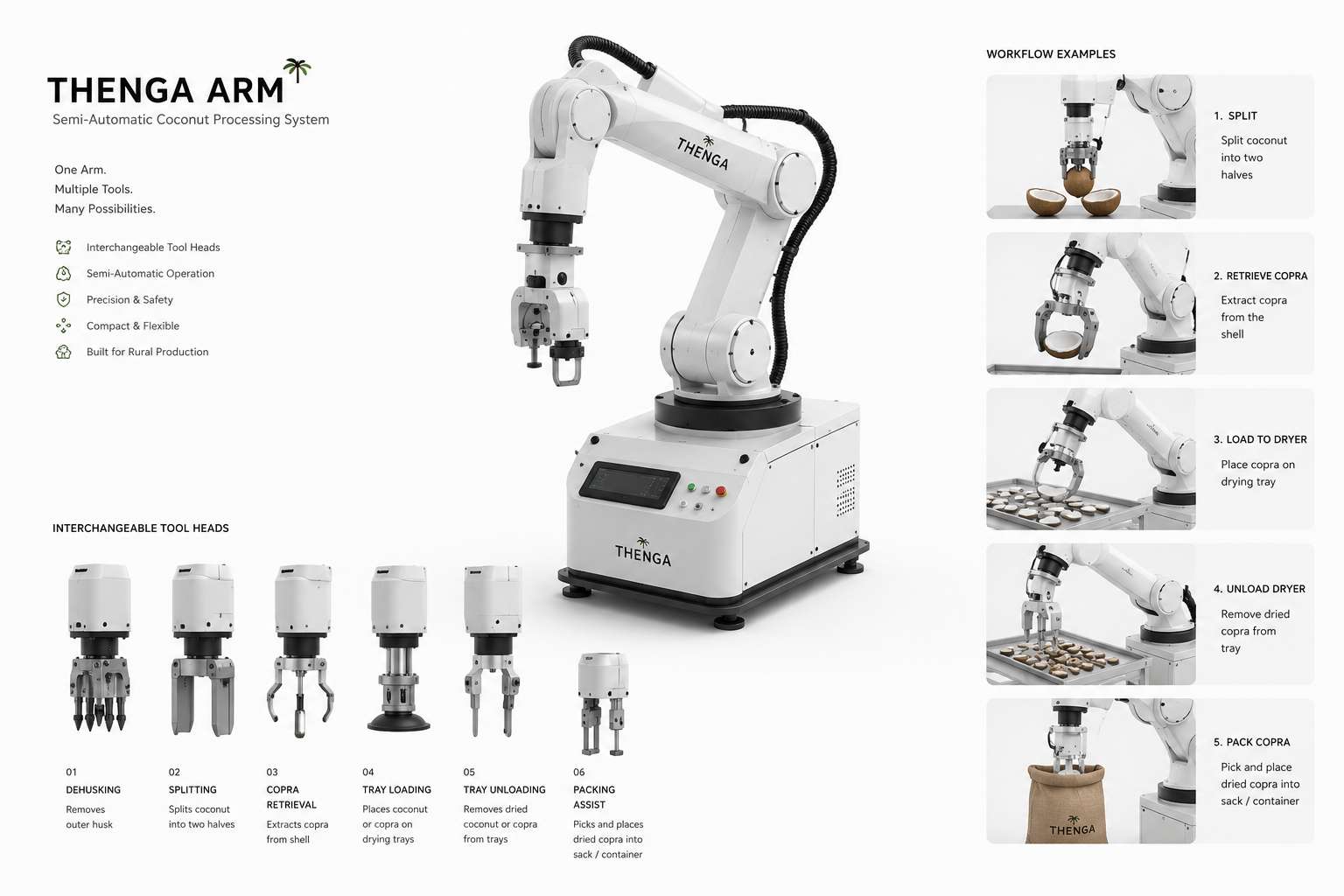
Dehusking
Removes outer husk
Splitting
Splits coconut into two halves
Copra Retrieval
Extracts copra from shell
Tray Loading
Places coconut or copra on drying trays
Tray Unloading
Removes dried coconut or copra from trays
Packing Assist
Picks and places dried copra into sack or container
Reflections
Designing for a Specific Context
Generic industrial robots exist. What doesn't exist is a machine that understands coconuts — their irregular geometry, variable moisture, fragile copra. The specificity of the problem was the design opportunity.
Two Products, One Language
THENGA ONE and THENGA ARM had to feel like siblings. Same visual language — white body, minimal detailing, green status cues — but scaled to completely different operational contexts.
Trust in Agricultural Machines
Farmers are pragmatic. A machine they can see into, service themselves, and understand at a glance is one they will trust. Transparent panels and clear stage labelling were as much UX decisions as aesthetic ones.
AI as a Design Tool
All renders in this case study were generated using ChatGPT. The thinking, the system logic, and the design language are real, even when the prototype is not. AI made it possible to visualise a complex industrial system at this level of detail without a full 3D modelling pipeline.